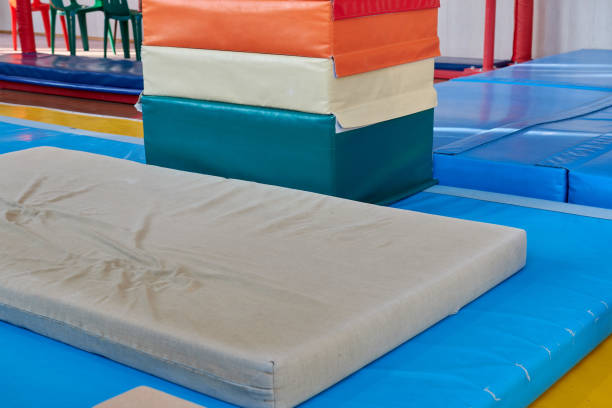
High-impact training spaces often contain a mixture of soft flooring and hard vertical surfaces. Athletes may be protected when they fall straight down, yet still face a hard boundary when momentum carries them sideways. The areas deserving most attention are not always the largest walls. They are the places where movement and a rigid surface are most likely to meet.
Beside grappling and takedown areas
Combat sports can move quickly beyond the centre of a mat. During wrestling, judo-style drilling or mixed martial arts training, two people may travel together toward the edge without either having a clear opportunity to stop. Wall mats can provide an additional protective layer where a training area sits close to a solid wall, but they should not replace suitable floor space, coaching control or safe boundary management.
Around indoor court run-off zones
Basketball, futsal and similar activities involve speed, changes of direction and attempts to keep a ball in play. A participant may reach the wall while looking elsewhere or after jumping. Facilities should consider the distance between court markings and nearby hard surfaces, along with doors, columns and projecting fittings. Padding may be particularly relevant where architectural constraints leave limited run-off space.
Near parkour and movement stations
Movement training can involve planned contact with walls as well as accidental impact. The appropriate surface depends on the drill. A wall intended for a foot plant or controlled touch may need different characteristics from a boundary that exists only as collision protection. Operators should avoid assuming that any soft-looking panel is suitable for active use as equipment.
Behind gymnastics and tumbling zones
Tumbling lines, trampoline approaches and skill stations can produce unexpected travel when a participant loses direction. Where a rigid wall sits near a landing or dismount area, wall mats may help reduce exposure to direct contact. The layout should still provide the clearance recommended for the apparatus or activity, and padding should not be used to shrink a safety zone specified by a governing body or manufacturer.
Along compact training lanes
Functional training facilities sometimes use narrow lanes for sleds, sprints, agility work or loaded carries. Fatigue can reduce control near the end of a repetition, while other users may be moving nearby. A hard wall at the end or side of a lane should be included in the facility’s risk review, particularly if people commonly approach it at speed.
Around columns and structural projections
Not every vertical hazard is a full wall. Columns, pilasters and corners can create concentrated impact points inside otherwise open spaces. Covering only the broad wall face may leave these features exposed. The padding design should consider edges and transitions so that a protective surface does not end immediately beside another hard projection.
In multi-use rooms with changing layouts
A room can be low risk in one configuration and very different in another. Movable goals, temporary mats, spectator seating or portable equipment may redirect activity toward a boundary that was previously remote. protective wall panels can suit flexible spaces, but their location should be reviewed whenever the programme changes.
Where supervision cannot control every approach
Coaching and rules are important controls, yet some activities naturally involve unpredictable movement. In busy sessions, participants can slip, be deflected by another person or misjudge distance. Padding is most valuable where those foreseeable errors lead toward a hard surface. It should form part of a layered approach that also considers instruction, spacing, floor condition and equipment placement.
Placement decisions should be based on observed movement rather than assumptions. Walking the room during different sessions, noting near contacts and checking clearances can reveal risks that are not obvious on a floor plan. Product thickness, firmness, fixing method and intended use should then be matched to the identified impact.
The strongest case for wall mats exists where a hard vertical surface sits inside a realistic fall, collision or run-off path. By concentrating on those locations first, facilities can make more purposeful decisions about coverage instead of padding walls simply because they are available.